
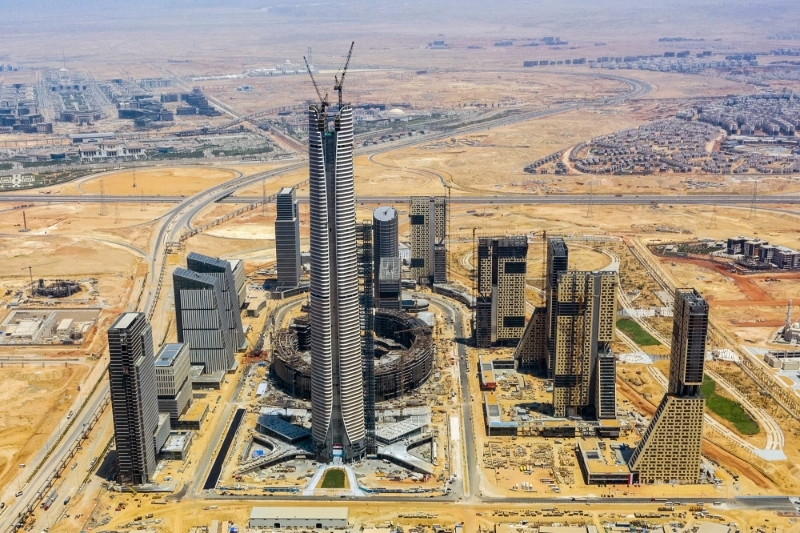
CAIRO — Rising from the desert 45 kilometers east of Cairo, Egypt’s New Administrative Capital (NAC) is rapidly transforming from a vision into a functioning city, with thousands of government employees now working from its high-tech government district . The megaproject, which began construction in 2015, is positioned as a “fourth-generation” smart city and a cornerstone of Egypt’s national strategy for urban development .
The scale of the undertaking is immense. Built on an area of approximately 170,000 feddans, the NAC is designed to eventually house 6.5 million residents across 21 residential districts . The city’s centerpiece is the Iconic Tower, Africa’s tallest building at 1,289 feet, soaring above a sprawling Central Business District . Other signature elements include the “Green River,” an artificial ecological corridor that stretches for kilometers across the desert landscape, designed to improve air quality and provide recreational space .
Government Relocation and Operations
The relocation of Egypt’s government apparatus to the NAC is nearing completion. In a significant milestone, the second phase of the relocation concluded recently, moving 19 ministries and government entities to the new capital, including the Ministries of Justice, Agriculture, Health, and Supply . With the completion of this phase, all ministerial headquarters have been moved from Cairo . The government district now houses 34 ministries, the Cabinet headquarters, and both chambers of parliament, with approximately 50,000 government employees eventually set to work there . The parliament itself has already held sessions in the new capital, including the recent vote of confidence for Prime Minister Mostafa Madbouly’s cabinet .
To facilitate this massive movement of people, new transportation links have been established. The monorail system, connecting East Cairo to the new city across a 35-mile elevated track, is now operational and has attracted significant public interest . This is complemented by an electric Light Rail Transit system that shuttles thousands of workers daily between Cairo’s suburbs and the Government District .
Economic Development and Investment
The project is being developed by the Administrative Capital for Urban Development (ACUD), the state-owned entity managing the site . Officials assert that the development is designed to be largely self-financing through land sales to private developers, with an estimated total cost of approximately $58 billion . The first phase of development has seen significant private investment, with reports of residential and commercial towers selling units at a rapid pace . To encourage further development, ACUD has recently offered new incentives for developers, including deferring payments and offering cuts in interest and overdue fines for land purchases .
Egyptian officials have been actively promoting the project as a crucial development for the nation’s future. The State Information Service has defended the project against international criticism, emphasizing that it provides hundreds of thousands of jobs and stimulates economic growth . Prime Minister Madbouly has called the NAC a “major urban transformation” and a smart, sustainable city built to international standards designed to serve as Egypt’s administrative, cultural, and economic hub .
Looking Ahead
Despite the progress, significant challenges remain. While the government has moved its headquarters, many employees still commute from Cairo daily due to the high cost of housing in the new city . To address this, developers have broken ground on a second phase focusing on more affordable housing and a dedicated Diplomatic District, which has already seen agreements for 20 foreign embassies to relocate . The construction rate on the second phase of state employees’ housing units has already exceeded 91 percent .
The project continues to be a subject of debate, with international observers questioning its impact on Egypt’s national debt and its long-term viability . However, for the Egyptian government, the NAC is a strategic necessity to alleviate the pressure on Cairo, whose population has swelled past 22 million, and to build a modern, sustainable hub for the nation’s future . The coming years will be critical in determining whether this ambitious city in the desert can achieve its goal of becoming a thriving, populated metropolis.