
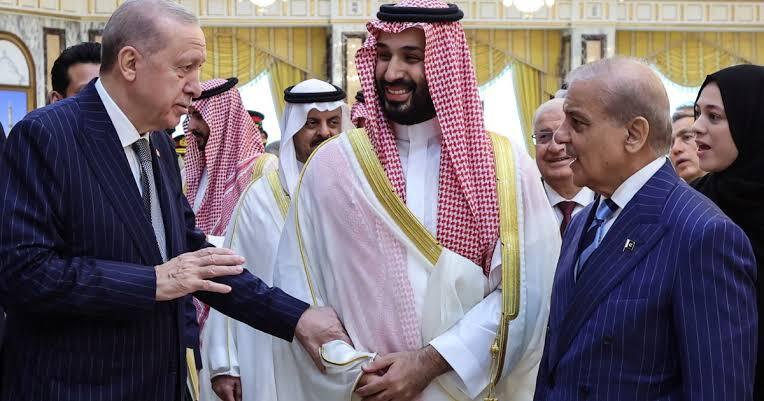
Pakistan, Saudi Arabia and Türkiye have signed a new Mecca Joint Defence Agreement, creating a trilateral security framework that includes a NATO-style collective-defence commitment: an armed attack against one of the three countries is to be regarded as an attack against all. The agreement was signed in Mecca by Saudi Crown Prince Mohammed bin Salman, Turkish President Recep Tayyip Erdoğan and Pakistani Prime Minister Shehbaz Sharif.
The pact could become one of the most consequential new security arrangements in the Muslim world, bringing together Saudi Arabia’s financial and energy power, Türkiye’s advanced defence industry and NATO experience, and Pakistan’s large military and nuclear deterrent.
Why the pact matters
The agreement comes amid a period of intense instability across the Middle East. Saudi Arabia has faced growing security threats, while uncertainty over the future role of external powers has encouraged Riyadh to strengthen its own regional security partnerships. Analysts have described the agreement as potentially contributing to a more regionally driven security architecture.
The three countries are not starting from zero. Pakistan and Saudi Arabia already have a bilateral strategic defence relationship, while Türkiye and Pakistan maintain extensive military cooperation. Türkiye is also a NATO member and possesses one of the alliance’s largest armed forces.
What could the alliance actually do?
1. Collective military response
The most important feature is the “attack on one, attack on all” principle. However, the agreement should not automatically be equated with NATO’s Article 5. NATO has decades of integrated command structures, established military planning mechanisms and permanent institutions. The new trilateral arrangement would need considerable time to develop comparable capabilities.
2. Joint military planning
The pact could lead to greater coordination among the three armed forces, including joint exercises, intelligence sharing, air-defence cooperation, maritime security and contingency planning.
Türkiye could contribute advanced drones, electronic warfare capabilities, missiles and defence technology, while Pakistan could provide substantial manpower, air-power expertise and military training. Saudi Arabia could provide funding, infrastructure and access to strategically important bases.
3. A stronger regional defence industry
The agreement could accelerate defence-industrial cooperation. Türkiye has emerged as a major exporter of drones and other military technologies, while Pakistan has developed experience in aircraft production, including the JF-17 programme. Saudi Arabia, meanwhile, has been seeking to expand domestic defence manufacturing.
A deeper partnership could therefore involve joint production, technology transfers, maintenance facilities and weapons-development projects.
Iran will be watching closely
The new alliance is likely to attract particular attention in Tehran. Iranian officials have already criticized the agreement, with one Iranian lawmaker arguing that a treaty on paper cannot by itself guarantee Saudi security.
The pact does not necessarily mean that the three countries are preparing for war with Iran. Türkiye and Pakistan have historically maintained channels with Tehran, and the agreement has been presented as defensive. Nevertheless, the collective-security clause could make any future attack involving Saudi Arabia considerably more complicated.
If Riyadh were attacked, Pakistan and Türkiye could face pressure to determine what level of military assistance the treaty requires.
What does it mean for the United States?
The agreement does not necessarily represent a break with Washington, but it signals that Saudi Arabia wants greater strategic autonomy.
For decades, Gulf security has depended heavily on American military power. A stronger Saudi-Turkish-Pakistani security network could give Riyadh another layer of deterrence and bargaining power.
For Washington, the development could therefore be both an opportunity and a challenge: the three countries could share more responsibility for regional security, but a new military bloc could also make regional crisis management more complicated.
What about India?
For India, Pakistan’s participation makes the development particularly significant.
Pakistan is the only nuclear-armed member of the emerging grouping, while Türkiye has developed increasingly close defence and political ties with Islamabad. The possibility of closer military coordination among Pakistan, Türkiye and Saudi Arabia could therefore become an important factor in India’s assessment of the wider strategic environment.
However, there is currently no basis to conclude that the pact is directed specifically against India. Its immediate context is regional security and the protection of Saudi Arabia and its interests amid escalating Middle Eastern tensions.
Could this become an “Islamic NATO”?
The phrase is politically powerful, but it may be premature.
A genuine NATO-style alliance would require much more than a mutual-defence declaration: permanent command structures, integrated forces, common operational planning, compatible communications systems, regular exercises and clearly defined procedures for responding to attacks.
The Mecca agreement could nevertheless provide the political foundation for such a structure if the three governments continue expanding military cooperation.
The biggest test: implementation
The real significance of the pact will depend on what happens next.
If the three countries establish permanent military mechanisms, conduct large-scale joint exercises, share intelligence and develop integrated air and missile defence, the agreement could evolve into a formidable regional security organisation.
If cooperation remains primarily political and diplomatic, its military impact could be considerably more limited.
For now, the agreement represents a major strategic development: three influential Muslim-majority states have formally committed to treating an attack on one as an attack on all, potentially reshaping the security balance stretching from South Asia to the Gulf and eastern Mediterranean.