
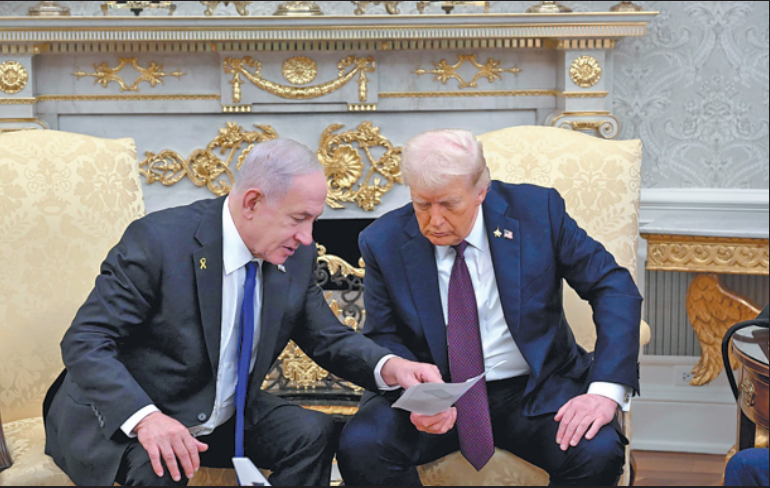
Israel Expresses Reservations Over Trump's Gaza Peace Plan, Citing Security Concerns
JERUSALEM – Israeli officials have voiced significant reservations about President Donald Trump’s recently announced Gaza peace plan, which was hailed by the White House as a “major milestone,” according to multiple reports . While the plan outlines a pathway involving the disarmament of Hamas and a phased Israeli withdrawal, Israel has publicly stated that the framework does not reflect its positions and fails to meet its security requirements.
Israeli Objections and Security Demands
Following President Trump’s announcement of what he termed a “historic agreement” on the “complete disarmament” of Hamas, Israel’s government was quick to temper the optimistic tone from Washington . Doron Spielman, a spokesman for Prime Minister Benjamin Netanyahu’s office, confirmed that Israel had conveyed “comments and concerns” to American counterparts, emphasizing that the publicized version “does not reflect Israel’s positions” .
Central to Israel’s opposition is the question of Hamas’s military capabilities. Israeli intelligence assessments indicate that since a ceasefire last October, Hamas has been actively rebuilding its forces and recruiting fighters, leading Israeli officials to argue that anything less than complete demilitarization would leave the group capable of future attacks . The Netanyahu administration insists that the “indispensable first step” toward any arrangement is the “genuine, verifiable, and irreversible demilitarisation of Hamas” .
Israeli officials have clarified that they will not withdraw from their current positions in Gaza—where they currently control between 60% and 70% of the territory—until Hamas is fully disarmed and its tunnel network destroyed . Furthermore, Israel has opposed the entry of an International Stabilization Force into Gaza, with reports stating that far-right cabinet ministers have called on Prime Minister Netanyahu to block such a deployment .
Disconnect Between U.S. Enthusiasm and Ground Reality
While President Trump touted the agreement as a breakthrough, his administration’s own envoy was set to meet with Israeli officials in an attempt to push for an end to renewed attacks . The diplomatic momentum has not translated into a halt of hostilities on the ground. Israeli airstrikes have continued across Gaza, with at least 18 Palestinians, including women and children, killed on a single day over the weekend . These strikes have shattered any sense of progress for many Palestinians.
Residents of Gaza described a grim reality at odds with the diplomatic language of peace. Much of the enclave remains in ruins, and nearly all of its over 2 million residents are displaced, confined to a tiny coastal strip in makeshift tents . Aya Mohammad Zaki, 32, reported by phone that “it was as if the war has resumed,” with attacks occurring across the territory . Another resident stated that while she hoped Trump’s announcement would bring change, “on the contrary, destruction increased, displacement increased” .
Hamas’s Conditional Acceptance
In response to the U.S. plan, Hamas announced it had agreed to the latest version of the roadmap for the second phase of the ceasefire agreement . A senior Hamas official stated that the group was ready to begin negotiations for a prisoner exchange and ensure the withdrawal of the Israeli army from Gaza . However, Hamas’s acceptance is conditional. The group insists that it will only proceed with the disarmament and weapons-handover process on the condition of a complete halt to Israeli “aggression,” a full Israeli withdrawal from the enclave, and progress on reconstruction . Hamas has also called on the mediators and guarantors of the ceasefire to pressure Israel to cease its violations .
The U.S. proposal calls for Hamas to hand over its weapons to a Palestinian technocratic committee and for Israel to withdraw in stages, linked to compliance verification . The plan is part of a broader effort that reportedly includes connecting the Gaza deal with the expansion of the Abraham Accords, a move analysts suggest is designed to placate Israel and solidify a regional security architecture . However, with Israeli strikes continuing and no deal on disarmament in sight, the gap between the White House’s declared victory and the situation on the ground remains wide .