
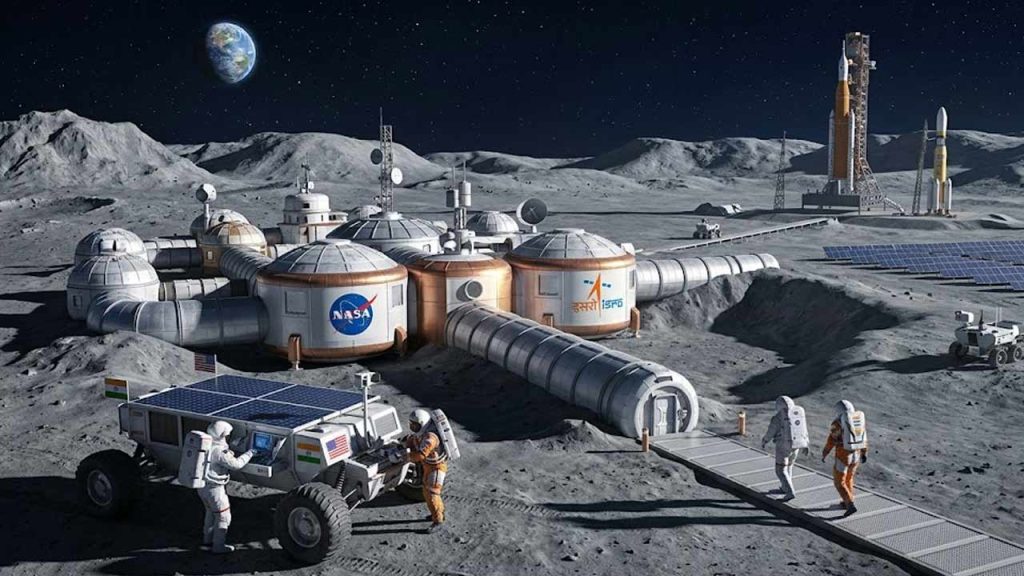
New Delhi, August 13, 2026: In a major development for India’s space ambitions, NASA has invited the Indian Space Research Organisation (ISRO) to participate in its Moon Base programme, opening the door to deeper cooperation between the United States and India in future lunar exploration.
The invitation was extended during the 9th India-US Civil Space Joint Working Group meeting, held in Bengaluru on August 5–6. The initiative is linked to the broader Artemis programme, which aims to establish a sustained human presence around and on the Moon.
India Could Play a Bigger Role in the Moon Base
NASA’s invitation signals growing recognition of ISRO’s capabilities following India’s successful Chandrayaan-3 lunar landing in 2023.
The exact role ISRO could play in the Moon Base programme has not yet been publicly defined. However, cooperation could potentially involve lunar science, robotics, communications, navigation, technology development and future human-spaceflight activities.
India became a signatory to the Artemis Accords in 2023, joining an international framework for cooperation in the peaceful and sustainable exploration of the Moon and beyond.
NASA Already Works With ISRO
The proposed Moon Base cooperation builds on an already strong NASA-ISRO relationship.
The two agencies successfully developed and launched NISAR, a joint Earth-observation satellite designed to study changes in Earth’s land and ice surfaces. NISAR was launched from India in July 2025.
NASA is also contributing a water-detection instrument to the LUPEX lunar mission being developed by ISRO and Japan’s JAXA. The mission is planned to investigate water and other resources near the Moon’s south pole, with a lunar rover targeted to arrive no earlier than 2028.
India Has Its Own Lunar Ambitions
The invitation comes as India develops an increasingly ambitious lunar roadmap.
ISRO’s future plans include Chandrayaan-4, which is intended to demonstrate advanced lunar capabilities including sample collection and return. The mission is currently targeted for around 2027 and is considered an important technological step toward India’s longer-term goal of sending Indian astronauts to the Moon.
India has also outlined a long-term ambition of achieving a crewed lunar landing by 2040, although that remains a future national objective rather than an imminent mission.
A New Chapter in the Moon Race
NASA’s invitation could give India an opportunity to participate more directly in the international effort to establish a sustained human presence on the Moon.
For the United States, cooperation with ISRO could bring additional scientific and engineering capabilities. For India, participation could accelerate technological development and provide experience in complex international human-spaceflight and lunar operations.
The development also comes at a time when the Moon is becoming a major focus of international competition and cooperation, with the United States, China, India, Japan and other nations pursuing increasingly ambitious lunar programmes.
NASA’s invitation to ISRO therefore represents more than another space agreement—it could mark India’s transition from a successful lunar explorer to a potential partner in building the next generation of lunar infrastructure.