
Global investment patterns are being reshaped by artificial intelligence, advanced manufacturing, digital infrastructure, clean energy and supply-chain diversification. In 2026, investors are increasingly looking beyond traditional financial centres and focusing on countries that combine economic growth, skilled talent, large consumer markets and strong long-term business potential.
According to PwC’s 29th Annual Global CEO Survey, the United States remains the world’s most preferred destination for cross-border investment, while India has risen to second place, alongside the United Kingdom and Germany. Around 13% of surveyed CEOs identified India as a preferred investment destination for 2026, up sharply from 7% in the previous year.
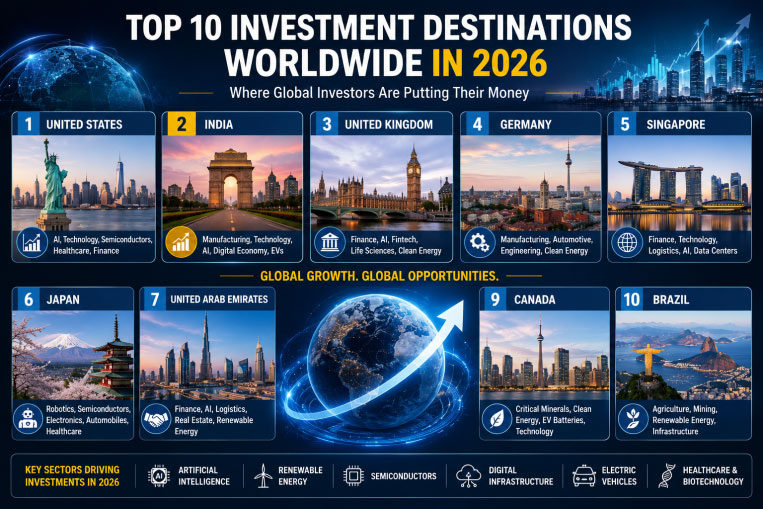
Here are the top 10 investment destinations worldwide in 2026, with India placed second.
1. United States
The United States continues to dominate global investment preferences, supported by its enormous consumer economy, technological leadership, deep capital markets and world-leading companies.
Artificial intelligence, semiconductors, data centres, biotechnology, defence technology and advanced manufacturing remain major areas of investment.
Key sectors: AI, semiconductors, technology, healthcare, finance and advanced manufacturing.
2. India
India has emerged as one of the world’s most attractive destinations for international capital. Its rise to second place reflects growing confidence in its economic growth, expanding consumer market, digital economy and manufacturing capabilities.
India is also strengthening its position in electronics, semiconductors, renewable energy, electric vehicles, pharmaceuticals, artificial intelligence and digital services.
The country’s appeal is supported by its large domestic market, expanding infrastructure and efforts to attract global manufacturing and technology investment. India’s FDI inflows reached approximately $38.89 billion in 2025, making it the world’s 11th-largest FDI recipient that year, according to UN-related data.
The Indian government has also highlighted the country’s strength in greenfield digital investment, with India attracting significant international investment into digital industries.
Key sectors: Technology, AI, electronics, semiconductors, renewable energy, EVs, pharmaceuticals and fintech.
3. United Kingdom
The UK remains a major global investment hub, particularly for financial services, artificial intelligence, fintech, biotechnology and clean energy.
London’s position as an international financial centre and the country’s strong research ecosystem continue to attract multinational companies.
Key sectors: Finance, AI, fintech, life sciences and renewable energy.
4. Germany
Germany remains Europe’s industrial powerhouse. Its highly developed manufacturing ecosystem and engineering expertise make it particularly attractive for investors in automobiles, machinery, industrial technology, chemicals and clean energy.
The transition towards electric vehicles and low-carbon manufacturing is also creating new investment opportunities.
Key sectors: Automotive, engineering, industrial technology, chemicals and clean energy.
5. Singapore
Singapore continues to serve as a major gateway to Asian markets. Its stable regulatory environment, sophisticated financial system, strategic location and strong digital infrastructure make it attractive to multinational corporations.
The country is particularly important for financial services, logistics, technology and regional headquarters.
Key sectors: Finance, technology, logistics, AI and data centres.
6. Japan
Japan combines advanced technology with a highly developed industrial base. The country remains a major destination for investment in robotics, electronics, automobiles, healthcare and semiconductor manufacturing.
Government efforts to strengthen domestic semiconductor production are also creating new opportunities for international companies.
Key sectors: Robotics, semiconductors, automobiles, electronics and healthcare.
7. United Arab Emirates
The UAE has transformed itself into one of the Middle East’s most important investment and business centres.
Dubai and Abu Dhabi continue attracting international capital into real estate, financial services, logistics, tourism, artificial intelligence and renewable energy.
Key sectors: AI, finance, real estate, tourism, logistics and clean energy.
8. Saudi Arabia
Saudi Arabia’s Vision 2030 programme is driving enormous investment across infrastructure, tourism, technology, energy and industrial development.
The country is seeking to diversify its economy beyond oil while developing new industries and attracting international businesses.
Key sectors: Infrastructure, tourism, AI, renewable energy, manufacturing and energy.
9. Canada
Canada offers investors access to natural resources, advanced research capabilities, skilled talent and a stable business environment.
The country’s critical-minerals reserves and growing electric-vehicle and battery industries are particularly important as companies diversify global supply chains.
Key sectors: Critical minerals, EV batteries, clean energy, technology and natural resources.
10. Brazil
Brazil remains one of Latin America’s most important investment markets because of its huge domestic economy, natural resources and renewable-energy potential.
Agriculture, mining, infrastructure, clean energy and electric mobility are attracting growing international interest.
Key sectors: Agriculture, mining, renewable energy, infrastructure and EVs.
Top 10 Investment Destinations at a Glance
| Rank | Country | Major Investment Strengths |
|---|---|---|
| 1 | 🇺🇸 United States | AI, technology, semiconductors, finance |
| 2 | 🇮🇳 India | Manufacturing, technology, AI, digital economy |
| 3 | 🇬🇧 United Kingdom | Finance, AI, fintech, life sciences |
| 4 | 🇩🇪 Germany | Manufacturing, automotive, engineering |
| 5 | 🇸🇬 Singapore | Finance, technology, logistics |
| 6 | 🇯🇵 Japan | Robotics, semiconductors, electronics |
| 7 | 🇦🇪 UAE | Finance, AI, logistics, real estate |
| 8 | 🇸🇦 Saudi Arabia | Infrastructure, energy, tourism, AI |
| 9 | 🇨🇦 Canada | Critical minerals, clean energy, EVs |
| 10 | 🇧🇷 Brazil | Agriculture, mining, renewable energy |
Why India Is Moving Up the Investment Rankings
India’s second-place position is particularly significant because its ranking has improved rapidly. In PwC’s previous survey, only 7% of global CEOs identified India as a preferred destination for capital allocation. That share increased to 13% for 2026.
Three factors are particularly important:
1. Large consumer market: India’s huge population creates opportunities across consumer goods, financial services, technology, healthcare and e-commerce.
2. Manufacturing expansion: Electronics, mobile phones, automobiles, pharmaceuticals and semiconductor-related industries are receiving increasing investment.
3. Digital economy: India’s digital public infrastructure, fintech ecosystem and rapidly expanding technology sector continue to attract international businesses.
Recent investment data also show continued interest in India. Foreign investors have committed new capital across areas including IT, artificial intelligence, manufacturing, pharmaceuticals, data centres and transport services.
The Investment Landscape Is Changing
The competition for international capital is becoming increasingly linked to technology, energy security and supply-chain resilience.
Countries that can provide skilled workers, reliable infrastructure, attractive policies and access to large markets are likely to remain major investment destinations.
For India, the challenge now is to convert growing investor interest into sustained investment, employment and domestic value creation. Recent data show both strong long-term interest and some short-term concerns among global portfolio investors, highlighting the importance of continued economic and market reforms.
Conclusion
The global investment map is undergoing a major transformation. The United States remains the leading destination, but India’s rise to second place highlights the country’s growing importance in the global economy.
With its expanding digital economy, manufacturing ambitions, young workforce and enormous domestic market, India is increasingly being viewed not only as a major emerging economy but as a potential long-term investment powerhouse.
The next few years could determine whether India can turn this growing global confidence into a sustained wave of investment across technology, manufacturing, infrastructure and innovation.